





















Data Resources
Air Pollution Data
PM2.5 Data and Life Expectancy Impact
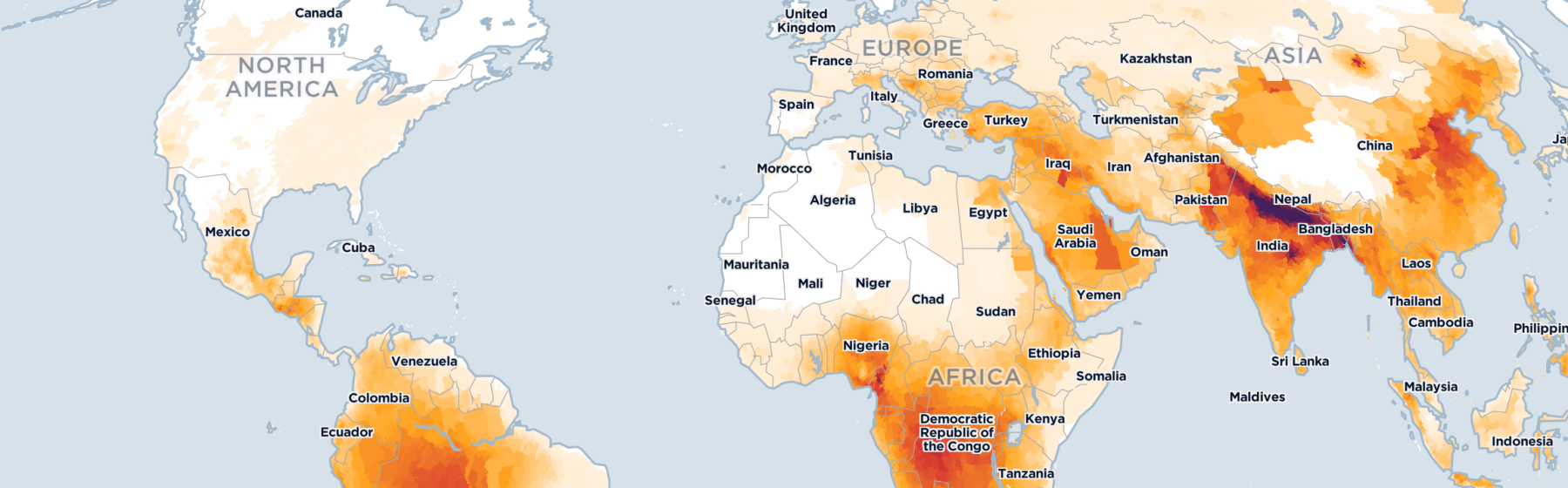
Access PM2.5 data at the district level for every country from 1998-2022, as well as the national annual standard for each country (if one exists). This dataset also includes the corresponding life years lost due to PM2.5 relative to if the district met the World Health Organization’s guideline for annual PM2.5 of 5µg/m3 and relative to if the district met its country’s national standard. The life expectancy data is a measurement from the Air Quality Life Index.
Strategic Air Pollution Funding Targeting
Access data and calculations for the EPIC Air Quality Fund Country Priority Scoring System. This system prioritizes countries’ need for open data and monitoring systems based on the impact having such a system would make on their pollution level. It scores countries based on: 1) The importance of PM2.5 pollution as an issue compared to other countries (e.g. severity of annual average PM2.5 levels as determined by satellite-derived estimates, size of population) and within the country itself (e.g. how high the issue ranks as a risk factor for mortality compared to other national issues); 2) The neglectedness of PM2.5 pollution relative to other countries in terms of resources invested by its government (e.g. lack of existence of government air quality monitoring or policy structures) or international donor funding; and 3) The tractability of contributing to tangible solutions in the country relative to others (e.g. opportunity to invest in basic data infrastructure due to a lack of current government investment and the existence of local groups with expertise and interest in monitoring PM2.5).
CLIMATE IMPACT DATA
Climate Projections
Access climate projection data for the Climate Impact Lab’s Impact Map. Projections available are derived from the Lab’s Global Downscaled Projections for Climate Impacts Research (GDPCIR), freely available on the Microsoft Planetary Computer. The GDPCIR dataset makes use of statistical bias correction and downscaling algorithms, which are specifically designed to accurately represent changes in the extremes.
View Impact Map dataset | View Microsoft Planetary Computer dataset
Climate Impact Modeling
Access data for the Data-driven Spatial Climate Impact Model (DSCIM), a robust, empirically-based model that the EPA has utilized for estimating and updated SC-GHGs. This dataset enables the calculation of sector-specific partial social cost of greenhouse gases (SC-GHG) and SC-GHGs that are combined across sectors. The main purpose of this library is to parse the monetized spatial damages from different sectors and integrate them into SC-GHGs for different discount levels, pulse years, and greenhouse gases.
View dataset | View user manual
Access data on sea level rise and temperature hazards and impacts of future climate change on the Human Climate Horizons platform. Hazard data includes: Average annual daily mean temperature, Daily maximum temperatures over 95F, Daily minimum temperatures under 32F, and local relative Sea level rise projections relative to a 1994-2014 baseline. Sea level rise is projected for three shared socioeconomic pathways (SSPs), considering only processes for which projections can be made with medium confidence, as defined by the Intergovernmental Panel on Climate Change (IPCC, Box 1.1). Temperature data is projected for two representative concentration pathways (RCPs) from the IPCC’s Fifth Assessment Report.
Mortality Costs
Access results and data for estimating the mortality costs of future climate change. This dataset uses comprehensive historical mortality records to quantify how death rates across the globe have been affected by observed climate changes by compiling the largest sub-national vital statistics database in the world, detailing 399 million deaths across 41 countries accounting for 55 percent of the global population.
Energy Costs
Access results and data for estimating the energy costs of future climate change. This dataset uses comprehensive historical energy consumption data derived from International Energy Agency data files to quantify how a population’s use of electricity and other fuels (for example, natural gas, oil and coal) energy consumption responds to climate changes.